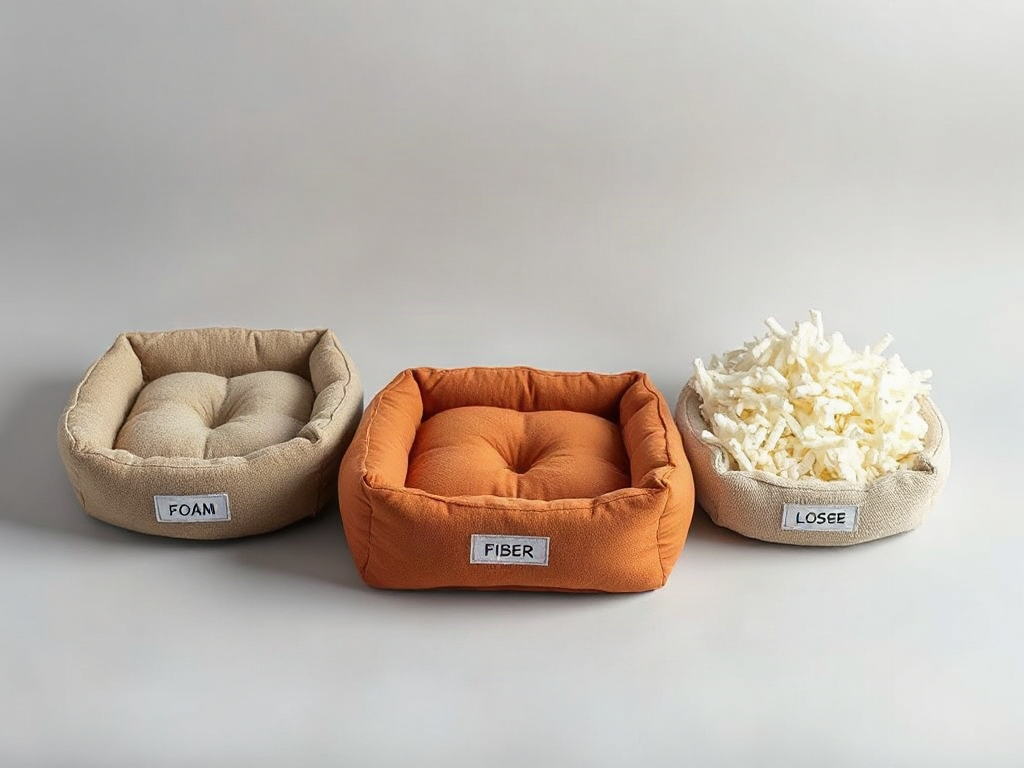
Pet bed filling types create distinct support differences through their firmness, resilience, heat retention, and resistance to flattening. Solid foam spreads weight across a stable surface, shredded foam allows more nesting, polyester fiber feels soft but compresses sooner, and loose natural fills can shift away from pressure points. The best choice should match the animal’s size, mobility, sleeping posture, and tendency to chew or burrow. Check whether the bed rebounds after use, keeps the sleeper off the floor, and can be cleaned without leaving damp material trapped inside.
What you’ll learn
This guide covers the following practical points:
- How Fill Construction Changes Support — Support comes from how a filling carries weight, not from how plush the top feels in a showroom.
- Foam, Fiber, and Natural Fill Compared — Each filling favors a different balance of stability, softness, temperature, maintenance, and cost.
- Matching Fill to the Animal and Sleeping Style — The animal’s body, movement, and preferred posture should determine the fill before appearance does.
- Durability, Cleaning, and Safety Checks — A filling has reached the end of its useful life when it no longer returns to an even shape or maintain separation from the floor.
How Fill Construction Changes Support
Support comes from how a filling carries weight, not from how plush the top feels in a showroom. A useful bed keeps the animal from sinking through to the hard surface beneath it while still allowing a comfortable resting posture. Thickness matters, but material density, rebound, and the way the fill moves under pressure matter just as much.
Solid foam distributes weight across one continuous layer. A firmer, denser slab generally resists bottoming out better than an equally thick layer of soft foam. Convoluted or “egg-crate” foam bends more readily around the body, although deep peaks alone do not guarantee durable support. Memory foam conforms slowly and can reduce concentrated pressure, but very soft versions may make turning or standing harder for an animal with limited mobility.
Loose fillings behave differently because individual pieces move. Shredded foam can form a nest while retaining more spring than ordinary fiber, but an unevenly filled casing may develop low spots. Polyester fiber initially creates a soft, lofty cushion, then mats as repeated pressure and washing alter its structure. A common mistake is judging support by hand compression at the edge; press the center down toward the base instead, then watch whether it recovers promptly and evenly.
Foam, Fiber, and Natural Fill Compared
Each filling favors a different balance of stability, softness, temperature, maintenance, and cost. No material is automatically best for every small animal, and marketing labels such as “orthopedic” do not reveal foam density, usable depth, or long-term resilience.
| Filling type | Support character | Main advantage | Likely limitation |
|---|---|---|---|
| Solid polyurethane foam | Stable and even | Resists shifting under the body | Quality varies; some foam softens quickly |
| Memory foam | Conforming and slow-rebound | Cradles body contours | May retain warmth or feel restrictive when very soft |
| Shredded foam | Moldable with moderate spring | Allows nesting and redistribution | Can become lumpy or migrate within the cover |
| Polyester fiber | Soft and compressible | Lightweight and commonly washable | Often flattens faster than quality foam |
| Natural loose fill | Variable and movable | May provide a distinct texture or cooler feel | Can shift, absorb moisture, or require careful drying |
Natural fills may include cotton batting, wool, or plant-derived materials. Their behavior is not interchangeable: cotton can compact, wool tends to retain loft better, and granular plant fills can settle toward the bed’s edges. Moisture exposure is a practical constraint because thick or densely packed natural material may dry slowly. The product’s care label and internal liner matter more than a broad “natural” claim.
Layered construction can solve competing needs. For example, a firm foam base can prevent floor contact while a thin fiber layer adds surface softness. The weak version of this design uses a very thin base hidden beneath excessive loft; once the fiber compresses, little functional support remains.
Matching Fill to the Animal and Sleeping Style
The animal’s body, movement, and preferred posture should determine the fill before appearance does. A compact animal that curls tightly may appreciate a moldable surface and raised perimeter, while one that stretches out needs usable flat space with consistent support from end to end. Measure the resting area inside any bolsters rather than relying on the product’s outside dimensions.
For an older animal or one that rises cautiously, prioritize a stable surface that does not collapse or slide sideways under the feet. A supportive foam base is often easier to push against than deep loose fiber. Veterinary input is appropriate when pain, weakness, skin sores, or a sudden change in sleeping behavior is present; a bed can improve resting conditions, but it is not a treatment for an underlying problem.
Burrowers and nest builders may prefer shredded fill or a softer upper layer they can rearrange. Active diggers, however, can concentrate material into ridges and expose the base. Animals that chew bedding need a different priority: access to foam, fiber, or loose fill can create an ingestion hazard. No filling makes a damaged bed safe, so inspect seams and remove the bed if the interior becomes accessible.
Use this short selection order:
- Confirm usable size: the animal should fit in its normal sleeping position.
- Check floor clearance: body weight should not compress the center to the base.
- Match stability: choose firmer construction when secure footing matters.
- Account for behavior: consider digging, burrowing, chewing, and soiling.
- Verify care needs: the filling must be practical to clean and dry fully.
Durability, Cleaning, and Safety Checks
A filling has reached the end of its useful life when it no longer returns to an even shape or maintain separation from the floor. Permanent hollows, hard clumps, crumbling foam, persistent odor, and dampness inside the core are failure signs. Rotating a symmetrical insert may slow uneven wear, but it cannot restore material that has broken down.
Removable, washable covers reduce how often the internal fill needs cleaning. A waterproof liner can protect foam from accidents, although a non-breathable barrier may hold warmth and makes trapped moisture harder to notice. After washing an approved insert, separate or redistribute loose material as directed and allow the core to dry completely before replacing the cover. A dry outer fabric does not prove that a thick center is dry.
Inspect the bed during routine cleaning rather than waiting for visible destruction. Run a hand over the sleeping surface to find thin areas, open the cover to check for foam dust or moisture, and examine zippers and seams. An unpleasant smell that returns soon after washing can indicate contamination inside the filling rather than on the cover.
Price is an imperfect durability signal. A replaceable foam insert and spare cover may offer better long-term value than a sealed bed that must be discarded after one accident. Conversely, an inexpensive fiber bed can be practical for frequent replacement when hygiene or destructive behavior makes longevity unrealistic. The mistake is paying for a premium label without checking the fill specification, internal construction, and cleaning instructions.
Frequently Asked Questions
Is memory foam always the most supportive pet bed filling?
No. Memory foam conforms well, but a very soft or thin layer can bottom out or hinder movement. Firmness, density, thickness, and the animal’s weight determine usable support.
How can I tell whether a pet bed is too soft?
Press the occupied area and observe the animal using it. Floor contact, deep sagging, unstable footing, or difficulty turning and rising suggest that the surface may be too soft.
Does polyester filling flatten quickly?
Polyester fiber commonly loses loft faster than resilient foam, especially with concentrated use and repeated washing. Baffled compartments can limit migration but do not prevent eventual matting.
Which filling is better for a pet that likes to burrow?
Shredded foam or fiber permits more rearrangement than a solid slab. Choose a securely enclosed design and inspect it frequently if the animal also scratches or chews.
When should a pet bed insert be replaced?
Replace it when permanent depressions, clumps, crumbling, exposed fill, retained moisture, or recurring odor remain after appropriate cleaning and drying.
Conclusion
Choose filling by testing usable support, stability, behavior compatibility, and cleaning practicality rather than relying on softness or an “orthopedic” label. Solid foam suits sleepers needing an even base, shredded material accommodates nesting, and fiber offers light cushioning with faster compression. Recheck the center for sagging, inspect seams and liners during cleaning, and replace any insert that stays damp, breaks apart, or exposes filling.
Additional Resources
Authoritative Sources
- AAHA Pet Health Resources
aaha.orgPet-health guidance from the American Animal Hospital Association.
- AVMA Pet Owner Resources
avma.orgVeterinary-backed pet health, safety, and care guidance.