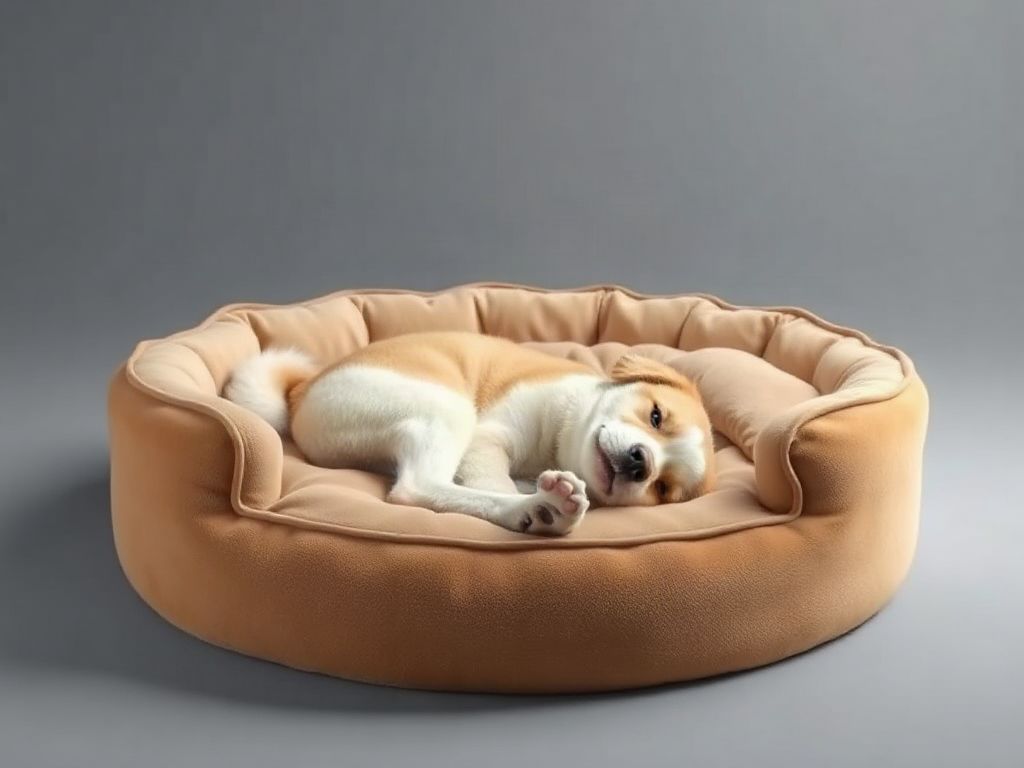
Round versus rectangular pet bed shapes suit different sleep positions, room layouts, and support needs: round beds favor pets that curl tightly, while rectangular beds better accommodate stretching, side sleeping, and changes in posture. Raised circular bolsters can create a sheltered resting pocket, whereas straight edges provide more usable length and often fit neatly beside furniture or inside crates. Measure the pet in its longest relaxed position rather than choosing by weight alone, then account for any padded rim that reduces the sleeping surface. A shape is failing when limbs spill over, the pet repeatedly relocates, or the bed blocks a walkway.
How Does Sleep Position Affect Bed Shape?
A pet’s habitual sleeping posture reveals more about suitable bed geometry than its weight category does. A pet that circles, tucks its nose toward its tail, and remains curled for most naps can settle naturally into a round sleeping area. The curved boundary follows the body’s compact outline, and a surrounding bolster gives the pet a surface against which to rest its back or chin.
Rectangular beds provide length in a direction that circular models cannot match without taking up substantially more floor space. They are usually the more efficient option for a pet that sleeps on its side, extends all four legs, alternates between curling and stretching, or changes position frequently. For example, a small dog may begin the night curled against one edge but later lie fully extended. A narrow round bed may feel suitable at first and become restrictive once the dog relaxes.
Posture also changes with temperature and location. Pets often curl to conserve warmth and spread out when they are warm, so a single observation on a cold evening can be misleading. Watch several sleep sessions in different conditions. Note whether the pet uses a wall or cushion as a backrest, places its head on a raised edge, leaves its legs outside the current bed, or abandons the bed after trying to reposition.
A common mistake is treating “likes to curl” as proof that a round bed is required. Rectangular beds with bolstered sides can offer the same enclosed feeling while preserving room to lengthen. Conversely, a flat circular cushion does not automatically provide a nesting sensation; the raised rim, fill distribution, and interior depth create that effect more than the outer outline alone.
Look for consistent behavior rather than an idealized product photograph. The shape is probably working when the pet can enter without hesitation, settle without repeated turning, and adopt its usual positions while keeping most of its body on the supportive surface. Frequent overflow is not necessarily a problem if the pet deliberately rests its head over a low edge, but hips or torso regularly landing on the floor usually indicate insufficient usable space.
Usable Space and Accurate Bed Measurements
Published dimensions may describe the outside footprint rather than the area available for sleeping. Thick bolsters can remove several inches from every side, making two beds with similar listed widths function very differently. A round model’s diameter must therefore be separated from its interior diameter, while a rectangular model needs both interior length and interior width checked.
Measure the pet while it is comfortably resting, not standing rigidly. For a curled sleeper, record the widest part of the curled body. For a side sleeper, measure from the nose or shoulder area to the rear feet in a relaxed extension, then measure the torso width. Add modest clearance so the pet can turn and reposition. There is no universal allowance that fits every species, posture, and bolster style, so compare the pet’s measurement directly with the manufacturer’s stated interior dimensions.
| Decision Point | Round Bed | Rectangular Bed |
|---|---|---|
| Dimension to verify | Interior diameter | Interior length and width |
| Best use of surface | Compact curled posture | Side sleeping and full extension |
| Effect of thick bolsters | Reduces usable space around the full circle | Reduces length and width, especially at corners |
| Typical sizing error | Using outer diameter as sleeping diameter | Checking length but ignoring narrow interior width |
Geometry creates another practical difference. A generous circular bed requires a large diameter to accommodate a long, stretched body, leaving unused space beside the pet. A rectangle directs more of its footprint along the body’s length. Round beds can still work for stretching if they are oversized, but the increased diameter may be awkward in a small room.
Do not choose from a weight range alone. Two pets of equal weight can have different body lengths, proportions, coats, and preferred postures. Weight can indicate whether the base fill is likely to compress, but it does not establish whether the sleeping surface is long enough. Product photos can mislead for the same reason, especially when the model animal’s size is not identified.
Before ordering, mark the bed’s outside dimensions on the floor with removable tape or sheets of paper. Then mark the smaller interior sleeping area within that outline. This quick check exposes two separate failures: a bed that fits the pet but not the room, and a bed that fits the room while leaving too little interior space. If measurements fall between sizes, prioritize the pet’s longest common posture unless the larger footprint would create a safety or access problem.
Which Shape Fits the Room Best?
Rectangular beds generally use corners and straight walls more efficiently, while round beds work well in open areas where their curved perimeter will not waste constrained floor space. Placement matters because a comfortable bed may go unused if it sits in a busy route, slides on the floor, or separates the pet from the household activity it prefers.
A rectangle can align with a sofa, cabinet, wall, or crate. Its straight edges reduce awkward gaps and make the footprint easier to predict. In a narrow bedroom, for example, a rectangular bed may sit flush at the foot of the human bed without protruding as far into the walking path. Rectangular pads are also the natural choice for most rectangular crates, provided the dimensions and materials are appropriate for the animal and the pad does not interfere with safe use.
A round bed may suit a quiet open corner, a broad landing, or a spot beside an armchair. It has no fixed head or foot orientation, so a pet can enter and face any direction. That flexibility is useful when the preferred view changes between a doorway, window, and nearby person. The tradeoff is that a circle placed against two straight walls leaves triangular gaps that cannot serve as sleeping space.
Door clearance deserves a physical test rather than a visual guess. A tall bolster can stop a cabinet door, catch under a room door, or narrow an already tight passage. The bed should also remain clear of heat sources, cords, unstable furniture, and areas where it is likely to be stepped on. For a household with multiple pets, allow enough surrounding room that one animal does not have to climb over another to reach a resting place.
The common failure is choosing the shape for décor first and forcing it into the available area afterward. Instead, identify two or three locations where the pet already chooses to rest. Measure each space, observe traffic at different times, and determine whether a circular or straight-sided footprint preserves a clear route. A bed is well placed when the pet uses it voluntarily, can approach from a comfortable direction, and is not repeatedly disturbed by doors, feet, or cleaning equipment.
Support, Access, and Daily Maintenance
Shape influences support mainly through edge design, entry height, and fill distribution rather than through the outline by itself. Round beds are commonly built with continuous bolsters, which can hold loose fill around a central cushion and provide contact on every side. Rectangular models may be flat, bolstered on three sides, or enclosed on all four sides, creating more options for pets that need both an open entrance and a raised headrest.
Pets with limited mobility may find a low front opening easier than a continuous high rim. A small animal should not have to jump, scramble, or collapse over the edge to reach the sleeping surface. A rectangular bed with a lowered entry can provide a clear approach, although some round beds also include a dipped front. If mobility has changed suddenly or the pet appears painful when lying down, shape selection should not substitute for veterinary assessment.
Base stability is equally relevant. A bed that rotates, folds, or slides during entry may be avoided regardless of shape. Check the floor-contact material, the stiffness of the base, and whether the fill bunches away from the center. On smooth flooring, a genuinely slip-resistant underside or a stable mat beneath the bed may matter more than choosing a circle or rectangle.
Cleaning tends to favor shapes that match available laundry and drying space. Rectangular covers often fold compactly and may be easier to align on a drying rack. Large round inserts can be cumbersome in smaller washing machines because they do not fold evenly, while continuous bolsters may trap moisture if the entire bed must be washed. These are construction differences rather than absolute rules, so inspect the care label and cover design.
Prioritize a removable, washable cover when shedding, tracked debris, or occasional accidents are expected. Examine zipper placement, inner liners, seams around bolsters, and whether separate components can be cleaned without washing the entire fill. A bed that technically fits a machine but cannot tumble or rinse freely may not clean well.
A frequent misconception is that a rounded nest is automatically warmer or that a rectangle is automatically more supportive. Warmth depends on fabric, loft, air movement, contact with the floor, and how tightly the pet curls. Support depends on the base material, thickness after compression, and whether the surface stays level. Compare those construction details independently from shape.
How Should You Choose Between the Two Shapes?
A reliable choice comes from ranking the pet’s posture, usable dimensions, entry needs, and placement before considering appearance. Shape should solve the most persistent constraint. For a dedicated curler in an open sleeping area, that may mean a round nest with an appropriately sized interior. For a pet that stretches beside a wall, it may mean a longer rectangle with one low side.
Use this compact check before buying:
- Observe: Record the pet’s two most frequent sleep positions across several days.
- Measure: Measure the relaxed body and compare it with interior—not exterior—bed dimensions.
- Place: Map the full footprint where the bed will sit and check doors and walking routes.
- Inspect: Evaluate bolster height, entry access, base stability, cover removal, and care instructions.
- Reassess: After placement, watch for regular use, easy repositioning, and adequate body support.
Consider a round bed when the animal consistently seeks a compact boundary, rarely sleeps fully extended, and has enough open floor area for the required diameter. Consider a rectangle when the pet alternates positions, needs greater length, sleeps near straight furniture, or will use the bed in a crate. A rectangular bolster bed can be a useful compromise because it offers defined edges without sacrificing a long sleeping axis.
Budget comparisons should focus on serviceable construction rather than shape alone. A less expensive bed with a nonremovable cover may cost more over time if odor, stains, or compressed fill make replacement necessary. Conversely, paying for deep bolsters offers little value if they reduce the center below the pet’s measured width or create a difficult entrance.
Allow a short adjustment period after placing a new bed, but do not dismiss clear signs of mismatch. Repeatedly sleeping beside it, placing most of the torso on the floor, struggling over the rim, or pacing before leaving suggests that size, location, texture, temperature, or stability needs review. Move the bed to a known resting location before assuming the shape is wrong. If use improves after relocation, placement was the stronger factor; if the pet still cannot adopt its normal posture, reassess the interior dimensions and edge design.
Frequently Asked Questions
Are round beds better for pets that curl up?
Round beds often suit consistent curlers because the curved edge surrounds a compact posture. Confirm that the interior diameter fits the curled body and that any bolster does not crowd the sleeping area.
Do rectangular beds provide more sleeping room?
They usually provide length more efficiently, especially for side sleepers and pets that stretch. Compare interior dimensions, since thick bolsters can substantially reduce the usable surface.
Can a round pet bed fit inside a crate?
A round bed may leave uncovered corners and may shift inside a rectangular crate. A correctly sized rectangular pad generally uses crate floor space more efficiently without bunching at the sides.
Should the bed have raised sides?
Raised sides suit pets that lean, curl against boundaries, or rest their chin on an edge. Choose a low entrance if a high continuous rim makes access difficult.
What if a pet sleeps beside the new bed?
First move it to a familiar resting spot and check for sliding, heat, unstable fill, or a restrictive interior. Continued avoidance may indicate that the shape, texture, edge height, or size does not match the pet’s habits.
Conclusion
The best outline is the one that accommodates the pet’s real resting posture without creating problems elsewhere in the home. Start by observing whether the animal curls, stretches, leans, or frequently changes position. Measure that posture and verify the bed’s interior surface, because outer dimensions and weight labels can conceal a cramped sleeping area.
Then test the footprint in the intended location, accounting for doors, walking routes, crates, and nearby furniture. Evaluate bolster height, entry access, base stability, and washing requirements separately from shape. Choose a round model for a compact sleeper that values surrounding contact and has sufficient open floor space. Favor a rectangle when usable length, flexible positioning, or alignment with straight boundaries matters more. After placement, voluntary use and comfortable repositioning provide better evidence than appearance alone.