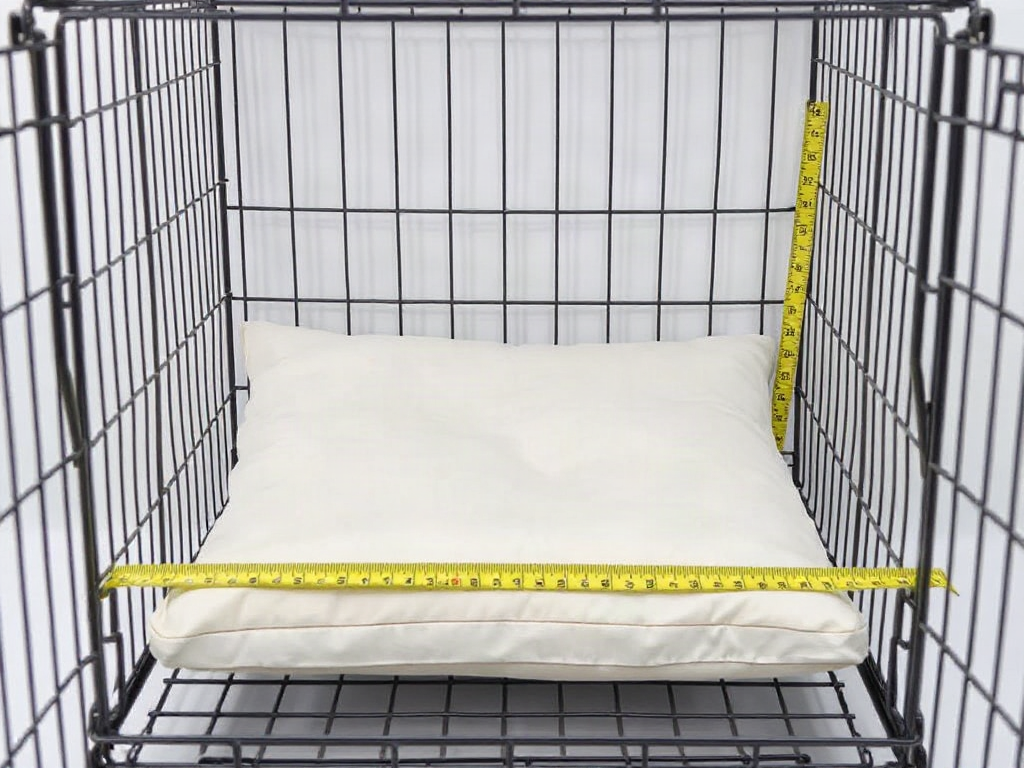
Crate-sized pet bed fit and clearance should allow the mattress to lie flat while preserving enough open space for the animal to stand, turn, settle, and change sleeping positions. Measure the crate’s interior floor rather than relying on its advertised size, then compare those dimensions with the bed’s finished length, width, height, and bolster profile. Avoid beds that buckle against the walls, obstruct the door, cover ventilation openings, or reduce usable headroom. After placement, check for sliding, folded edges, compressed padding, restricted movement, and any exposed gaps where paws or fasteners could become trapped.
What you’ll learn
This guide covers the following practical points:
- Measure the Usable Crate Interior — The usable floor area can be smaller than the dimensions printed on a crate label.
- Match Bed Dimensions and Construction — Finished bed dimensions matter more than the size named on the packaging.
- Check Movement, Door, and Ventilation Clearance — Clearance is functional space, not an arbitrary border around the mattress.
- Test the Installed Bed — A dry fit without the animal reveals construction problems; supervised use reveals whether the arrangement actually works.
Measure the Usable Crate Interior
The usable floor area can be smaller than the dimensions printed on a crate label. Product measurements may describe the exterior shell, while an inward-swinging door, rounded corners, wire joints, molded lips, or a removable tray reduces the space available for bedding. Measure the interior after the tray and every permanent fitting are in their normal positions.
Record the flat floor length and width at the narrowest points. Measure interior height from the top of the tray to the lowest overhead obstruction, not simply to the crate roof. If the doorway has a raised threshold, note its height and the depth of the space immediately behind it. A thick mattress that fits the floor can still make entry awkward by creating a high step beside that threshold.
Use a firm tape measure and check both ends of a tapered or molded crate. For a wire crate, measure between the inner faces of the wire panels. For a hard-sided carrier, follow the largest uninterrupted rectangular area rather than including curved corners that cannot support the bed. Write down the dimensions instead of assuming that products carrying the same nominal crate size will match.
Match Bed Dimensions and Construction
Finished bed dimensions matter more than the size named on the packaging. A flat mat can often use nearly the full floor footprint, whereas a bed with side bolsters needs space for its outer walls as well as its smaller sleeping area. Compare the crate measurements with the product’s external dimensions and, for a bolstered design, its internal lying dimensions.
| Bed feature | Dimension to verify | Likely fit problem |
|---|---|---|
| Flat mat | Finished length, width, and thickness | Edges curl or the mat slides |
| Bolstered bed | Outer footprint and inner sleeping area | Bolsters consume turning space |
| Deep cushion | Loft under the pet’s weight | Reduced headroom or unstable footing |
| Rigid-base bed | Exact base shape and corner profile | Base cannot settle flat on the tray |
Soft filling does not make an oversized bed a good fit. Forcing a cushion into a shorter crate creates humps, compressed seams, and raised edges. Those distortions can make footing less predictable and may encourage chewing at fabric pushed against the wire. At the opposite extreme, a noticeably undersized mat may drift across a slick tray or leave a narrow perimeter gap that collects paws, tags, crumbs, or loose bedding.
Account for the cover as well. Piping, handles, zipper garages, and thick seams can add bulk beyond the advertised sleeping surface. If the cover may shrink after washing, follow its care instructions and remeasure the assembled bed before treating the initial fit as final.
Check Movement, Door, and Ventilation Clearance
Clearance is functional space, not an arbitrary border around the mattress. The animal should be able to enter without catching a paw on a folded edge, stand without being pushed into the roof, turn without climbing over a large bolster, and lie in a natural position. A pet that can only curl tightly may need a larger crate, a thinner bed, or both.
Door operation deserves a separate check. Open and close every door slowly with the bed installed. The mattress should not drag beneath the panel, press against a latch, or spring into the opening. In a carrier with low ventilation slots, tall bolsters should not cover the lower openings. Bedding must also remain clear of any divider attachment, exposed connector, or tray mechanism that could pinch fabric.
Prioritize the animal’s normal posture over wall-to-wall coverage. A slim mat is often the practical choice where a plush cushion removes too much vertical room. A modest bolster may suit an animal that rests against an edge, but high sides are a poor trade when they shrink the central sleeping area. If the pet has difficulty stepping up, select a low, stable entry edge rather than compressing a thick bed under the doorway.
Test the Installed Bed
A dry fit without the animal reveals construction problems; supervised use reveals whether the arrangement actually works. Press across the surface to confirm that the base stays flat and that no corner rocks, folds, or lifts. Run a hand around the perimeter to find tight pinch points, protruding hardware, and gaps hidden by the cover.
Use this compact installation check:
- Set the clean, fully assembled bed on the crate tray without forcing it.
- Operate the door, latch, divider, and removable tray through their normal range.
- Confirm that ventilation openings remain exposed and loose fabric cannot reach moving parts.
- Supervise the pet entering, turning, standing, and settling in more than one position.
- Inspect again after use for migration, bunching, chewing, dampness, or compressed edges.
A working fit remains stable while the pet changes position and leaves the doorway usable. Repeated circling without settling, reluctance to enter, bracing against the roof, or choosing the bare edge of the tray can indicate lost space or an unsuitable surface. Those behaviors do not identify a single cause by themselves, so also consider temperature, cleanliness, pain, anxiety, and crate familiarity. Persistent mobility changes or signs of discomfort warrant discussion with a veterinarian.
Recheck the setup after laundering, replacing the tray, moving a divider, or changing covers. Foam can expand after unpacking, filling can settle, and covers can alter the final footprint. Regular inspection matters particularly for animals that chew, dig, or pull bedding toward the door.
Frequently Asked Questions
Should a crate bed fill the entire floor?
It may cover most of the flat floor if it lies level and does not interfere with the door, ventilation, or movement. Wall-to-wall coverage is not useful when it makes the bed buckle or creates pinch points.
Should I use the crate’s advertised dimensions to buy a bed?
Use measured interior dimensions instead. Advertised measurements may describe the exterior and may not account for trays, thresholds, rounded corners, dividers, or door hardware.
How much headroom should remain above a thick bed?
Enough for the animal to stand naturally without pressing its head or back into the crate roof. Measure with the mattress compressed under normal body weight, because loft varies by construction.
Can I fold an oversized cushion to make it fit?
Folding creates an uneven surface and raised edges that may obstruct movement or invite chewing. A correctly sized mat or thinner cushion is a more stable choice.
Why does a correctly measured bed still bunch up?
The cover may add bulk, the crate may narrow at one end, or the base may slide on a smooth tray. Recheck finished dimensions and corner shape, then consider a fitted non-slip base if it is intact and safe for the pet.
Conclusion
Measure the crate where the bed will actually sit, compare finished external dimensions, and judge the installed setup by usable movement rather than label size. Favor a flat, stable surface over a cushion that must be squeezed into place. Once installed, test the door, ventilation, headroom, turning space, and perimeter gaps, then watch how the pet enters and settles. Recheck after washing or changing any crate component because the effective fit can change.